Managing hotel operating expenses is not simply about spending less. A hotel can reduce a particular cost and still become less profitable if the change lowers service quality, affects occupancy or creates additional costs elsewhere.
The practical goal is to identify unnecessary spending, improve productivity and control costs while protecting the guest experience and revenue performance. This requires more than reviewing the total amount spent each month. Hotel managers need to understand which departments are driving costs, how those costs change with occupancy and where operational improvements can make a measurable difference.
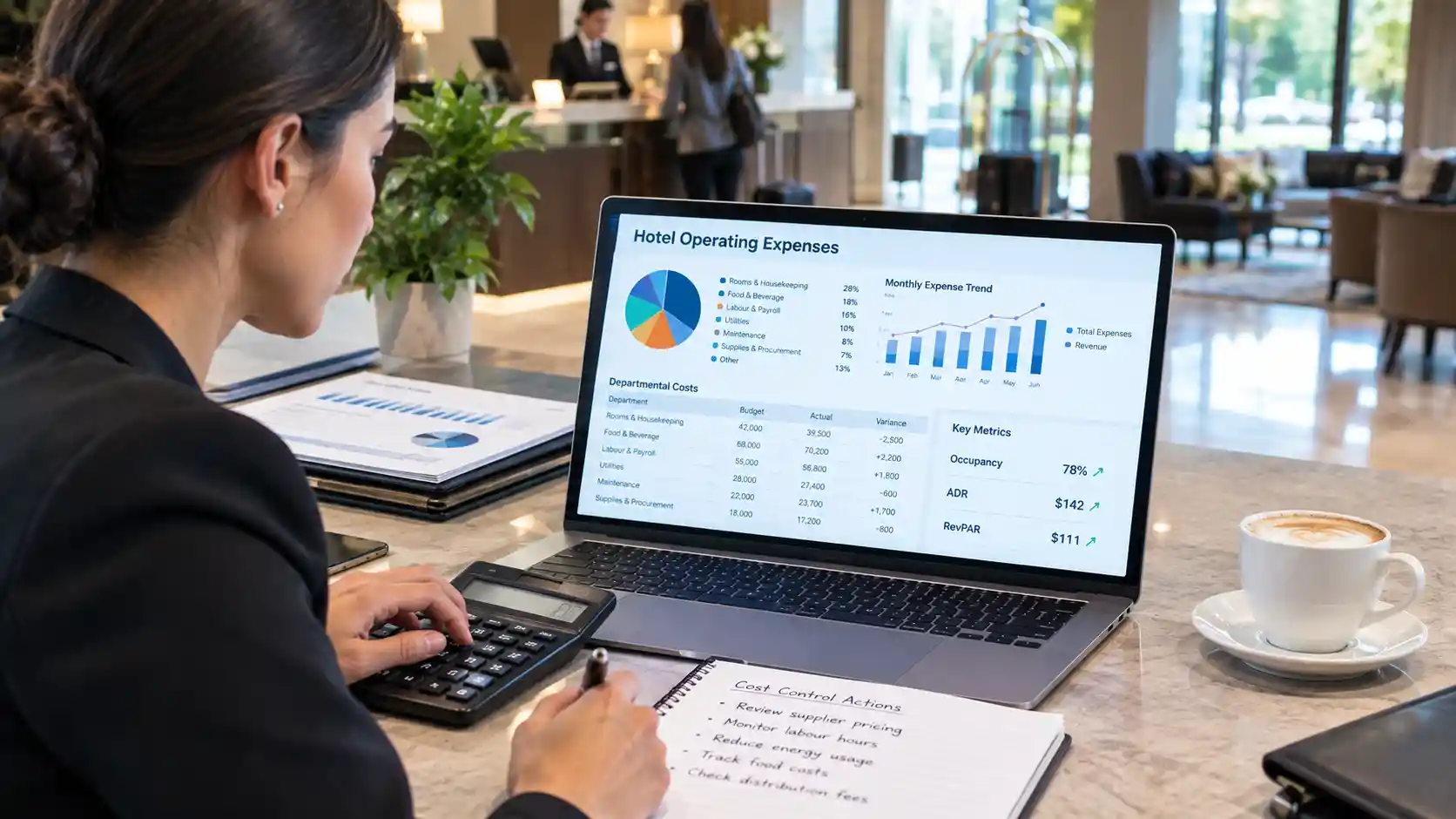
A useful starting point is to combine financial reporting with operational measures. Reviewing expenses alongside occupancy, average daily rate (ADR) and RevPAR can help management understand whether a cost reduction is actually improving the hotel’s overall financial performance. For broader financial planning, see the guide to hotel finance management.

Types of Common Hotel Expenses
Hotel expenses vary according to the property’s size, service level, facilities and operating model. Instead of treating every expense as simply fixed or variable, it is more useful to consider fixed, variable and semi-variable costs.
Fixed costs generally do not change directly with short-term occupancy. Examples can include property-related costs, certain insurance expenses, some licences and other contracted overheads. However, these costs can still change over time or contain variable components.
Variable costs tend to increase or decrease with guest activity. Housekeeping supplies, guest amenities, food ingredients and some hourly labour costs are examples.
Semi-variable costs contain both fixed and usage-related elements. Utilities, maintenance and some labour arrangements can fall into this category depending on how the hotel operates.
Hotel managers should also track expenses by department rather than relying only on a total monthly figure. Common areas include:
- Rooms and housekeeping
- Food and beverage
- Labour and payroll
- Utilities and energy
- Laundry and linen
- Maintenance
- Procurement and supplies
- Distribution and payment costs
- Technology and software
The useful question is not simply, “What did we spend?” It is, “What caused the cost, how does it relate to occupancy or revenue, and can it be controlled without creating a larger problem?”
How to Reduce Hotel Operating Expenses
Measure the costs that matter
Before changing an expense, establish a consistent way to measure it. Total monthly spending can hide operational problems, particularly when occupancy changes significantly between periods.
Useful hotel operating measures can include labour cost per occupied room, departmental cost per occupied room, energy cost per occupied room and food cost percentage. Revenue measures such as occupancy, ADR and RevPAR should also be considered when assessing whether a cost-control decision is improving profitability.
For example, a higher housekeeping cost in a busy month does not automatically indicate poor cost control. The more useful comparison may be the housekeeping cost per occupied room and the service level achieved.
Regular reporting can also help identify unusual increases, recurring expenses and departments that are consistently performing outside their budget or operating expectations. Accurate records are particularly important when comparing actual results with forecasts. hotel bookkeeping services can support this type of financial record-keeping.
Match labour to demand
Labour is often a significant hotel operating expense, but reducing headcount is not automatically the right solution. Understaffing can increase workloads, create service problems and leave managers dealing with avoidable operational issues.
A better approach is to align staffing with expected demand. Occupancy, arrivals, departures, group bookings, events and expected service requirements can all help inform rosters.
Cross-training can also give managers more flexibility during changing demand periods, provided employees are appropriately trained for the duties they perform. Routine administrative tasks may also be streamlined with suitable technology, allowing staff to spend more time on work that requires direct guest interaction.
Payroll should be monitored alongside productivity rather than treated as an isolated expense. For hotels that need more structured payroll processes, payroll services for hospitality businesses is a relevant internal resource.
Control energy, water and laundry costs
Energy and water costs can be affected by occupancy, equipment, operating hours, building systems and maintenance. Instead of relying only on general reminders to switch off lights, hotels can look at the major sources of consumption, including HVAC systems, hot water, refrigeration, lighting and laundry operations.
Monitoring energy use against occupancy can provide a more useful picture than looking only at the monthly bill. Where appropriate, hotels can consider efficient equipment, room controls, preventive maintenance and operating procedures that reduce unnecessary consumption.
Water-saving measures can also affect laundry costs. Linen and towel programmes, efficient fixtures and sensible laundry procedures can reduce resource use without making assumptions about guest behaviour.
The potential financial benefit will depend on the property’s equipment, usage patterns and energy arrangements, so savings should be measured rather than assumed. A practical sustainability reference is the Free Hotel Sustainability Checklist.
Review procurement and supplier costs
Supplier prices are only one part of procurement. A cheaper unit price does not necessarily mean a lower overall cost if it requires larger minimum orders, creates storage problems, increases spoilage or ties up working capital.
Review purchasing arrangements for food, beverages, cleaning products, guest amenities, linen and other frequently ordered supplies. Compare suppliers based on price, quality, delivery requirements, minimum quantities and reliability.
Regular contract reviews can also identify subscriptions or services that are no longer being used effectively. Where appropriate, hotels can negotiate terms based on actual purchasing volumes and operational requirements rather than automatically committing to larger quantities for a discount.
Reduce food, beverage and inventory waste
Food waste can arise through over-purchasing, poor forecasting, incorrect storage, excessive preparation and portioning issues. Better inventory controls can address these problems before they become significant costs.
Regular stock checks, appropriate storage, purchasing based on expected demand and production controls can help reduce unnecessary waste. Portion sizes should also be reviewed against actual guest demand and menu performance.
Surplus ingredients should only be reused where this is permitted by the hotel’s food-safety procedures and applicable requirements. Similarly, food donation should only be undertaken where it is practical, safe and supported by an appropriate documented process.
The same principle applies beyond food. Hotels should monitor guest amenities, cleaning products, linen and other consumables to avoid excessive stock levels, damage and unnecessary replacement.
Use technology where it solves a real operational problem
Technology can reduce manual work, improve visibility and help staff manage information, but installing software does not automatically reduce costs.
A property management system (PMS) can support functions such as reservations, room assignments, billing and housekeeping coordination. A booking engine can support direct reservations, while a revenue-management system may assist with pricing and inventory decisions where the hotel uses such technology.
These systems serve different purposes, so hotels should assess them according to the operational problem they are intended to solve. Digital check-in may reduce repetitive administration in some properties, but staff still need to handle exceptions and provide guest support.
Financial automation can also improve reporting and reduce manual processing. The article on automating financial management in hospitality provides further context.
Consider distribution and payment costs
Hotel profitability can be affected by costs that are easy to overlook when reviewing departmental expenses. Distribution commissions, payment-processing fees and other transaction-related charges can reduce the net value of a booking.
This means managers should consider not only the room rate and occupancy generated by a channel, but also the associated cost of acquiring and processing that booking. Direct and third-party distribution should be assessed using the hotel’s actual commercial arrangements.
Revenue performance should also be considered before making major cost reductions. Hotel Revenue & Yield Management explains how revenue and pricing decisions fit into wider hotel performance management.
Make maintenance more proactive
Reactive maintenance can create avoidable disruption and potentially higher costs when small problems develop into larger repairs. Preventive maintenance schedules can help hotels identify equipment issues earlier and keep important systems operating as intended.
Maintenance spending should therefore be assessed alongside equipment condition, service requirements, downtime and replacement costs. Cutting necessary maintenance may reduce short-term expenditure while increasing longer-term risk.
Conclusion
Effective hotel expense management is a process of measure, diagnose, change and review. Start by understanding costs at departmental level, then compare them with occupancy, revenue and operational activity. From there, focus on controllable areas such as labour planning, energy, procurement, inventory, technology, distribution and maintenance.
The aim is not to remove every expense. It is to remove avoidable waste and improve productivity while protecting service quality and revenue performance.
Hotels that need a broader financial view can also review Hotel Finance 101: Your Complete Guide and Solutions or explore Accounting for Hospitality for related financial management support.
FAQ
What are the biggest operating expenses in a hotel?
There is no single largest expense for every hotel because the cost structure depends on the property’s size, service level, facilities and operating model. Labour, utilities, food and beverage, property-related costs, maintenance and distribution expenses can all be significant.
How can a hotel reduce labour costs without affecting service quality?
Hotels can improve labour productivity by matching rosters to expected demand, reviewing workloads, cross-training staff where appropriate and reducing unnecessary manual administration. The objective should be better productivity and service alignment rather than simply reducing the number of employees.
How can hotels reduce energy costs?
Hotels can monitor energy consumption against occupancy and review major sources such as HVAC, hot water, refrigeration, lighting and laundry. Efficient equipment, appropriate controls and preventive maintenance may help reduce unnecessary consumption, although the potential savings depend on the property and its operating conditions.
How can hotels control supplier and procurement costs?
Review supplier pricing, contract terms, minimum order quantities, delivery arrangements and product usage. Bulk purchasing should be assessed against storage capacity, spoilage, cash tied up in inventory and actual demand rather than unit price alone.
How can hotels reduce food and beverage waste?
Hotels can improve forecasting, purchasing, storage, stock rotation, preparation and portion control. Tracking waste by type and department can help identify where losses occur. Any reuse or donation of surplus food should follow applicable food-safety procedures and requirements.
How do hotel operating costs affect profitability?
Operating costs directly affect the amount of revenue retained by the business, but expense reduction should not be assessed in isolation. Occupancy, ADR, RevPAR, distribution costs and service performance should also be considered when evaluating the financial effect of an operational change.
Which hotel costs should managers monitor regularly?
Managers should monitor departmental labour, housekeeping and room costs, food and beverage costs, utilities, laundry and linen, maintenance, procurement, distribution and technology expenses. The most useful measures will depend on the hotel’s operating model, but cost per occupied room and relevant departmental percentages can make comparisons more meaningful.